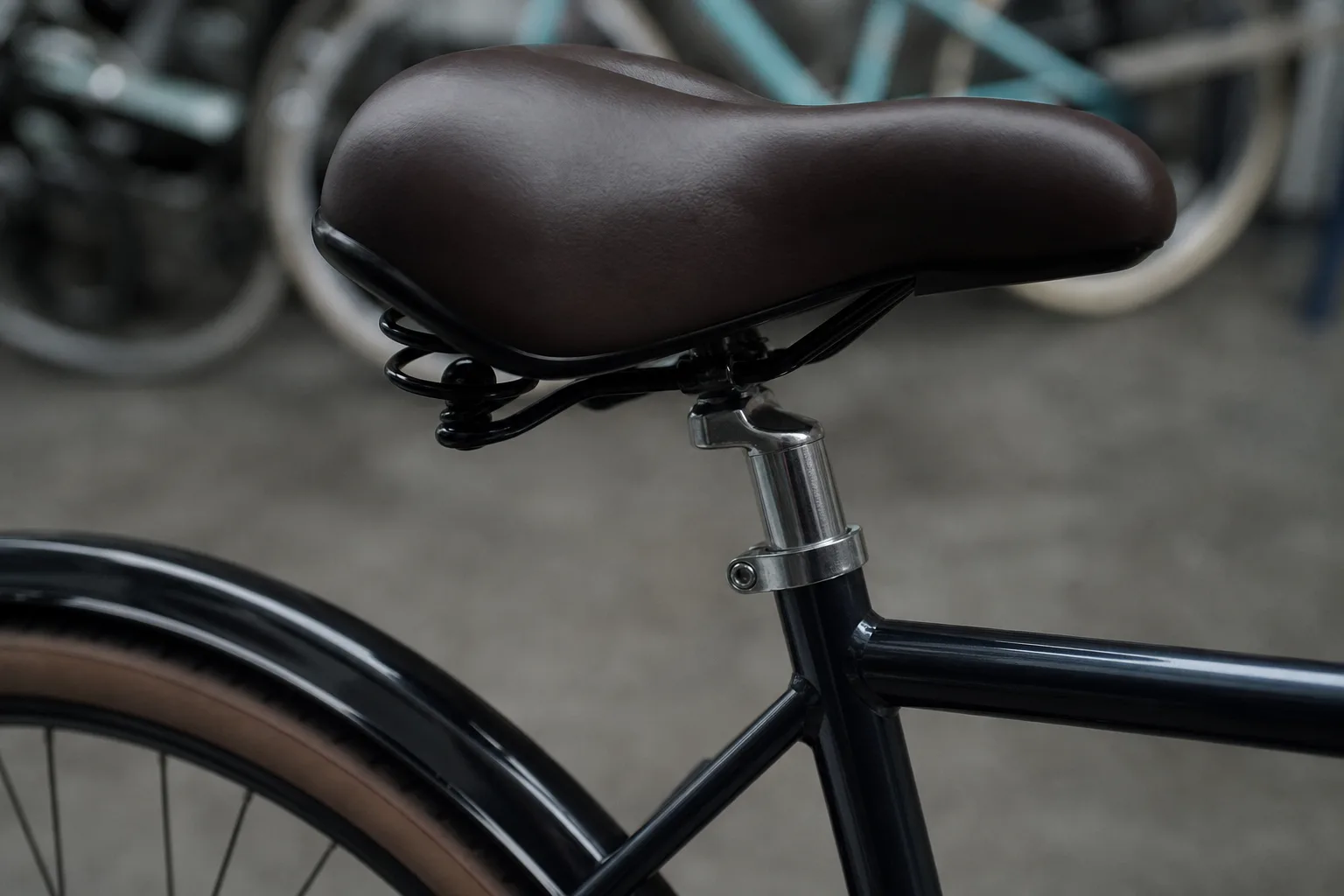
A bike that hurts after twenty minutes is rarely the wrong bike. It is more often a bike with a saddle two centimeters too narrow, tires inflated to a number printed for a rider forty pounds lighter, and a bar sitting an inch below where the rider's shoulders want it. The parts that decide comfort on a flat, unhurried ride are small, cheap, and mostly replaceable with hand tools. What follows is the order a careful reader should work through them, what each part can honestly fix, and what it cannot.
Saddle width, measured rather than guessed
On an upright bike the pelvis rotates back and the sit bones, the two ischial tuberosities, carry nearly all the load. That makes width the single measurement worth taking before buying anything. Sit on a piece of corrugated cardboard laid over a stair tread, lean the torso up to something near riding angle, stand, and measure center to center between the two dents. Most adults fall somewhere in the 100 to 145 millimeter range. An upright saddle usually wants that number plus roughly 20 to 30 millimeters. A correctly wide saddle costs less than most people expect and solves bruising and soft-tissue pressure; it will not fix a saddle set too high.
Tire volume and the pressure you actually run
Tire pressure is the cheapest change on the bike, because it costs nothing but a pump and five minutes. A 38 to 50 millimeter tire on a flat-riding cruiser or comfort hybrid does not need the sidewall's maximum figure, which is a structural limit rather than a recommendation. Dropping pressure meaningfully below that maximum, while staying high enough that the rim never bottoms out on a curb cut, removes most of the road buzz that riders blame on the frame. Wider tires, if the frame and fenders have clearance, extend the same effect further. Neither fixes a saddle that is the wrong shape.
Stem and bar rise, the inches that set your neck angle
Hand numbness and a sore neck usually trace to the same cause: too much weight forward, too little bar height. Two parts control this. A quill stem, common on cruisers and step-throughs, can often be loosened and raised, though never past the minimum insertion line stamped on the shaft. A threadless stem can be flipped, shimmed with spacers, or swapped for one with more rise. Riser bars or a swept-back cruiser bar bring the grips back and up together, sometimes by three or four inches. This is the change with the largest effect per dollar, and the one most often skipped.
Grip shape, which decides where the wrist sits
A round rubber grip supports the hand at one narrow point, and the ulnar nerve runs directly under that point. Swept ergonomic grips with a flared shelf spread the load across the base of the palm and hold the wrist closer to neutral. They are inexpensive, and lock-on versions install in minutes with a single hex bolt. Grip diameter matters too: smaller hands are better served by a slimmer grip than the fat foam sold as comfort. Grips relieve pressure and tingling; they will not correct a bar three inches too low, which loads the hands no matter what covers them.
Pedal position and foot placement
On a flat-pedal upright bike, the ball of the foot should sit roughly over the pedal spindle, and a wide platform, ideally 90 millimeters or more across, gives the foot somewhere to spread. Cramped, curled toes and arch ache usually mean a small pedal or a foot placed too far forward. Saddle fore-aft position works with this, since sliding the saddle back a centimeter changes the knee's relationship to the pedal. The Consumer Product Safety Commission is responsible for the federal requirements bicycles are built to, including pedal and reflector rules, so replacement platforms sold in the US meet a common baseline.
Testing one change at a time
The discipline that makes all of this work is boring: change one thing, ride the same route, and note what happened. Riders who swap a saddle, raise the bar and re-inflate the tires in the same afternoon learn nothing about which change helped, and often reverse a good one along with a bad one. Give each adjustment two or three rides of similar length. Write down the seat height in millimeters before you touch anything, so there is always a known position to return to. Most discomfort resolves inside these five parts, and the total spend stays modest.